Understanding ETFs: The Building Blocks of Momentum Strategies
If you've been following this series, you know that momentum investing means putting money into whatever's been performing well and pulling back from what hasn't. But there's a practical question we haven't answered yet: what are you actually buying and selling?
For most momentum strategies, the answer is ETFs.
What is an ETF?
An ETF (exchange-traded fund) is a basket of investments bundled into a single thing you can buy or sell on a stock exchange, same as you'd buy a share of Apple or Google.
Say you want to invest in the 500 largest American companies. You could buy shares of each one individually — hundreds of trades, tens of thousands of dollars, a lot of spreadsheet management. Or you could buy one share of SPY (the SPDR S&P 500 ETF) for around $500 and own a slice of all 500 in a single trade.
How it works: a fund manager assembles a collection of stocks, bonds, or other assets, then sells shares of that collection on the open market. Buy one share, and you get proportional exposure to everything inside it (Ferri, 2009). That's really all there is to it.
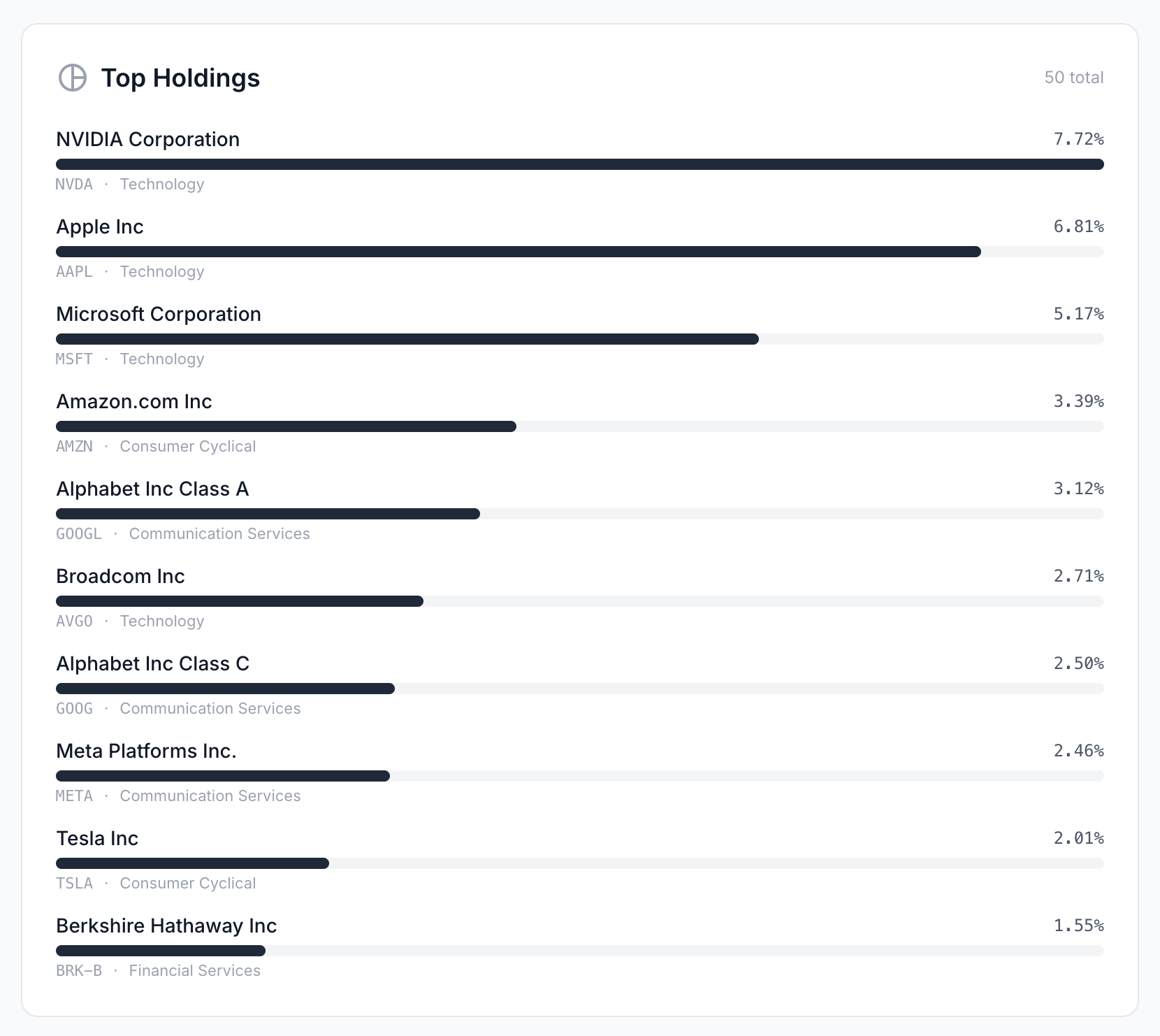 Source: Top Holdings for SPY.US etf-mapper.com
How ETFs compare to mutual funds and individual stocks
If you're new to investing, you've probably heard all three terms thrown around, sometimes interchangeably. They're not the same thing.
Trading. ETFs trade on an exchange throughout the day, just like stocks. You can buy at 10:03 AM and sell at 2:47 PM. Mutual funds only trade once per day — at a price calculated after markets close. If something happens at noon, you can't act on it until tomorrow.
Cost. The cheapest S&P 500 ETFs charge 0.03% per year (Vanguard, 2024). Index mutual funds average about 0.42%, and actively managed funds can charge 1% or more (ICI, 2025). Individual stocks have no ongoing fees, but the time you spend researching them isn't free either.
Diversification. One ETF share can give you exposure to hundreds or thousands of securities. Mutual funds are also diversified, but less flexible in timing. Individual stocks give you zero diversification — one bad quarter and you feel all of it.
Minimum investment. A single ETF share can cost as little as $30–$100, and many brokerages offer fractional shares. Mutual funds often require $1,000–$3,000 upfront. Individual stocks vary wildly — from under $10 to Berkshire Hathaway territory.
For momentum strategies specifically, ETFs check every box: they trade like stocks so you can react to signals quickly, they give you broad exposure instead of single-company risk, and the fees are low enough that periodic rebalancing doesn't eat your returns.
Why momentum strategies need ETFs
Momentum means regularly comparing assets and shifting money toward whatever's been gaining strength. To do that, you need investments that are cheap to trade (because you're rebalancing monthly or quarterly), diversified (because "US stocks are strong" should mean broad exposure, not one company), liquid (millions of shares traded daily), and simple to access through a regular brokerage account.
John Bogle, who founded Vanguard, spent decades making the case that low costs and diversification are what actually drive long term wealth (Bogle, 2007). ETFs happen to deliver both without much effort on your part.
The ETFs we use at reblnc
Our momentum models compare asset classes and sectors to figure out where strength is building. Here are the ETFs that show up in our strategies.
Core asset class ETFs
These cover the basics: US stocks, international stocks, and bonds.
SPY (SPDR S&P 500 ETF Trust) tracks the 500 largest US companies. It was the first ETF listed in the US back in 1993 and is still the most traded (SPDR, 2024). Expense ratio: 0.0945%.
VEU (Vanguard FTSE All-World ex-US ETF) covers thousands of stocks across developed and emerging markets outside the US. Expense ratio: 0.07% (Vanguard, 2024).
AGG (iShares Core U.S. Aggregate Bond ETF) covers the US investment-grade bond market — government, corporate, and mortgage-backed. This is your safety allocation when the model wants you out of stocks. Expense ratio: 0.03% (iShares, 2024).
TIP (iShares TIPS Bond ETF) holds Treasury Inflation-Protected Securities, bonds that adjust their value with inflation. Useful when inflation is rising and regular bonds are losing ground. Expense ratio: 0.19% (iShares, 2024).
Sector ETFs
These let you focus on specific industries. When momentum favors technology over healthcare, you can tilt accordingly.
XLK (Technology) — Apple, Microsoft, Nvidia. XLV (Health Care) — pharma, biotech, health insurers. XLF (Financials) — banks, insurance, financial services. XLE (Energy) — oil, gas, energy companies. Can surge when commodity prices spike. XLY (Consumer Discretionary) — non-essentials: Amazon, Tesla, Nike. XLP (Consumer Staples) — essentials: Procter & Gamble, Coca-Cola, Costco. Tends to hold up when everything else is falling.
All SPDR sector ETFs carry an expense ratio of 0.09% (SPDR, 2024). That's 90 cents per year for every $1,000 invested.
Factor ETFs
These target specific investment characteristics.
MTUM (iShares MSCI USA Momentum Factor ETF) holds US stocks with strong recent price performance. It's literally a momentum ETF. Expense ratio: 0.15% (iShares, 2024).
VLUE (iShares MSCI USA Value Factor ETF) holds stocks that look undervalued relative to fundamentals. Momentum and value tend to rotate — when one cools off, the other often picks up. Expense ratio: 0.15% (iShares, 2024).
A momentum strategy doesn't just pick one of these and sit on it. It compares them against each other, checks which categories are gaining strength and which are fading, and shifts your allocation toward what's working. More ETFs in the model means it can target momentum more precisely.
The cost question
Every ETF charges an annual fee called the expense ratio. It's a percentage of your investment, deducted automatically — the fund takes a tiny fraction out each day and you never see a bill.
At a 0.03% expense ratio, $10,000 invested costs you $3 per year. At 1.0% (typical for an actively managed mutual fund), that same $10,000 costs $100 per year. Doesn't sound like much either way.
But costs compound. Over 30 years with a 7% annual return before fees, $10,000 at 0.03% grows to about $74,000. At 1.0%? About $57,000. That $17,000 difference is money that would have been compounding in your account the whole time (Bogle, 2007).
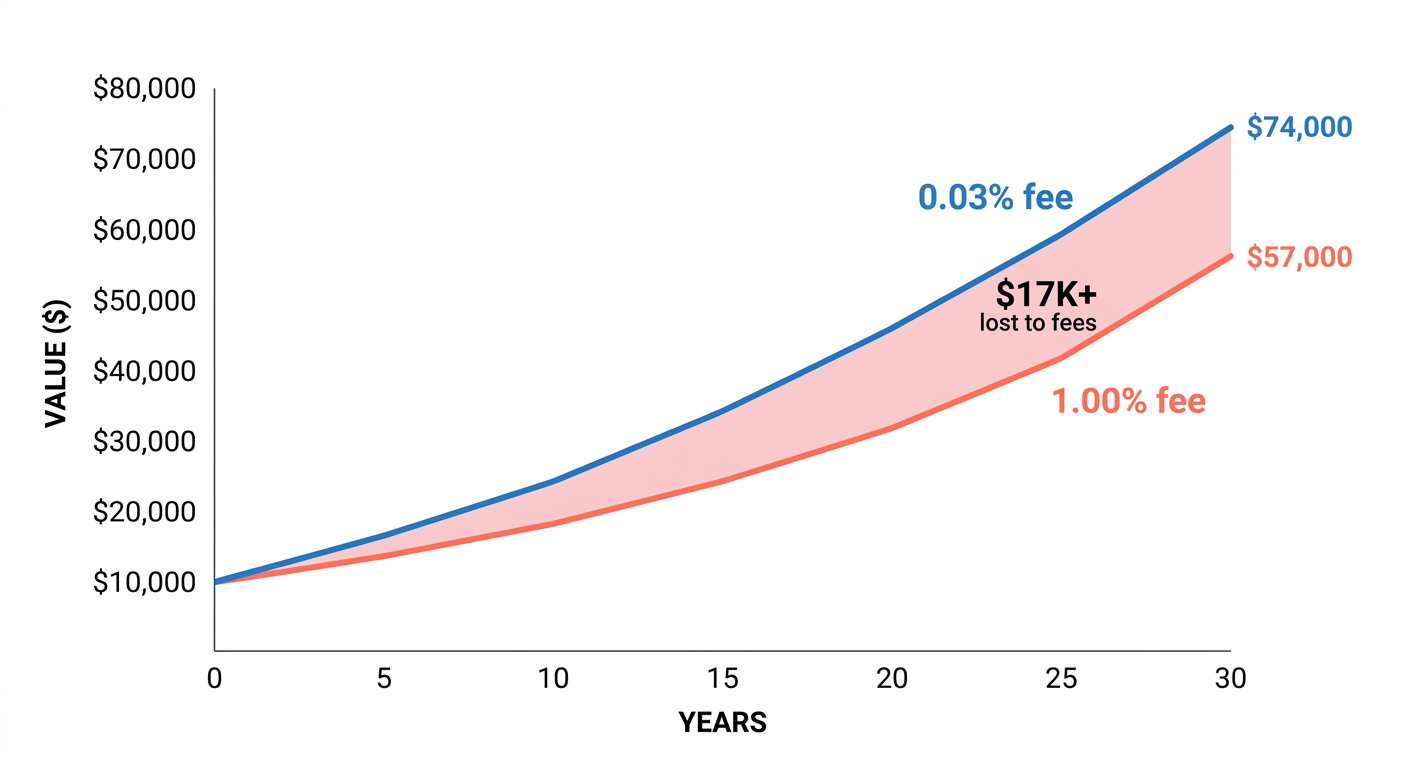
For momentum strategies that rebalance periodically, keeping these costs low matters even more. Every rebalance is a chance for fees to take a bite.
ETFs by the numbers
Some context on how big ETFs have gotten, from the Investment Company Institute's 2025 report:
Total US ETF assets crossed $10 trillion for the first time in 2024. Net inflows hit $1 trillion in a single year — also a first. There are now over 3,600 ETFs available in the US, with 757 new ones launching in 2024 alone (46% more than the 2023 record). The growth has been steady for years and shows no sign of slowing down (ICI, 2025).
Buying your first ETF
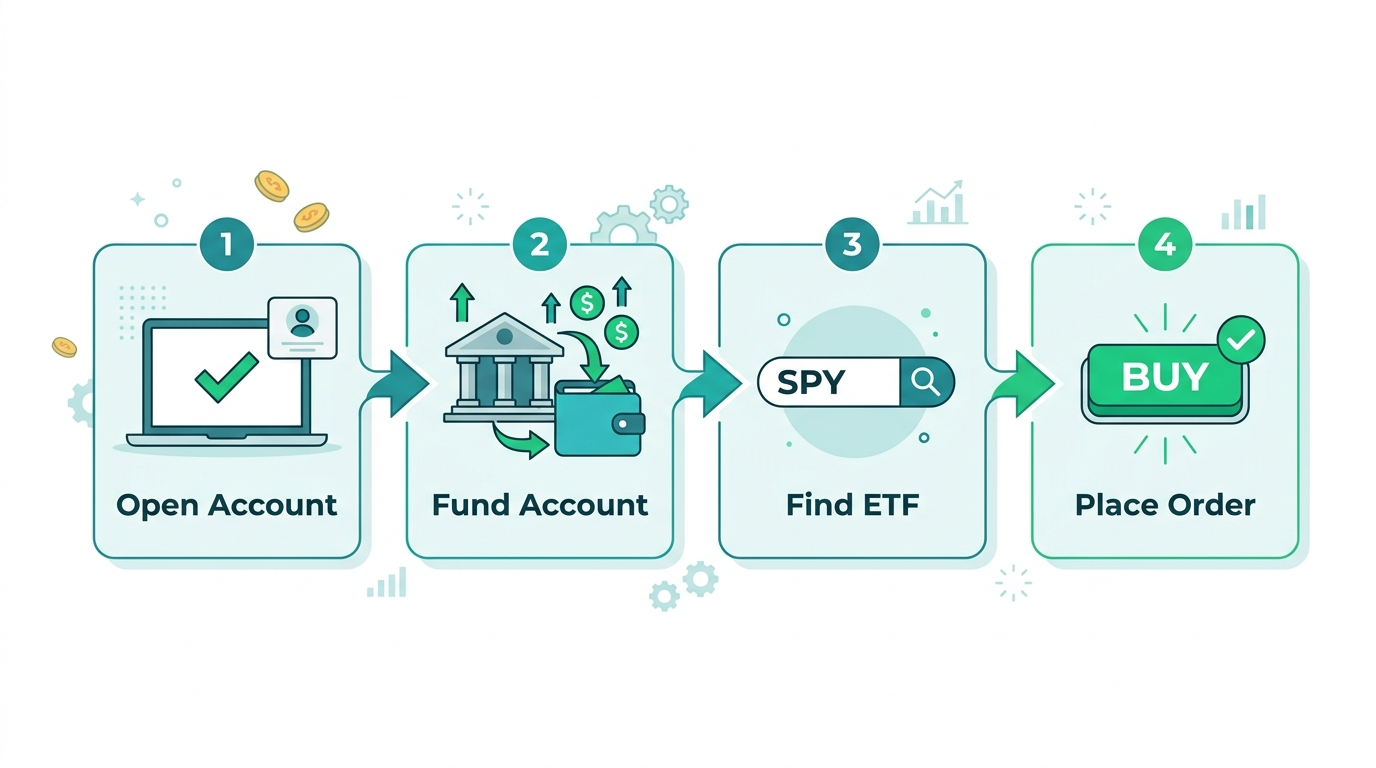
The process is the same as buying a stock.
Open a brokerage account with Fidelity, Schwab, Vanguard, Interactive Brokers, or similar. Most offer free ETF trades and no minimums. Takes about 15 minutes online.
Fund the account by linking your bank. Transfers usually take 1–3 business days, though some brokers give you instant access.
Search for the ETF by ticker symbol. Type "SPY" or "AGG" into the search bar and you'll see the price, volume, and fund details.
Place your order. A market order buys at the current price. A limit order lets you set a maximum — useful if you're buying something less liquid. Most brokerages also support fractional shares, so you can start with $50 if that's what you have.
Coming up next
The next article takes these ETFs and puts them to work. We'll walk through how momentum signals actually decide which ones to hold and when to switch — the point where theory turns into a portfolio you can use.
Sources and further reading
- Bogle, J.C. (2007). The Little Book of Common Sense Investing. John Wiley & Sons.
- Ferri, R.A. (2009). The ETF Book: All You Need to Know About Exchange-Traded Funds. John Wiley & Sons.
- Investment Company Institute (2025). "Five Takeaways from the 2025 Fact Book." ici.org
- Vanguard (2024). Fund documentation for VEU, VOO, and other Vanguard ETFs. vanguard.com
- iShares by BlackRock (2024). Fund documentation for AGG, TIP, MTUM, and VLUE. ishares.com
- State Street Global Advisors (2024). SPDR ETF fund documentation. ssga.com
- ETF.com (2024). "ETF Education." etf.com
Subscribe to our research
Get the latest tactical allocation strategies and academic whitepapers delivered to your inbox.